What Is a Petty Knife? Kitchen Essential
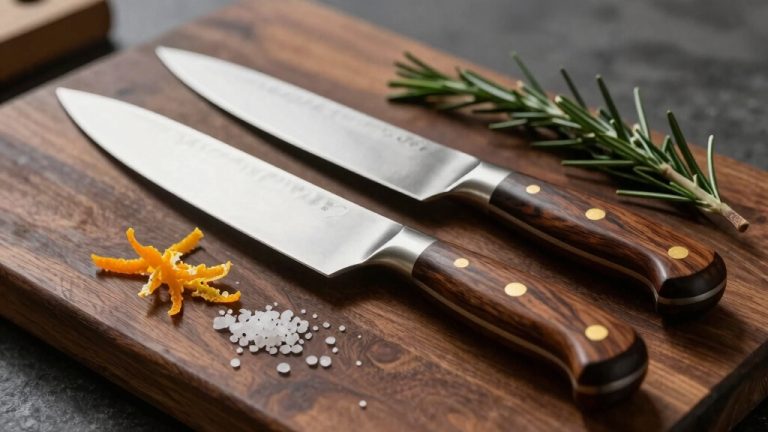
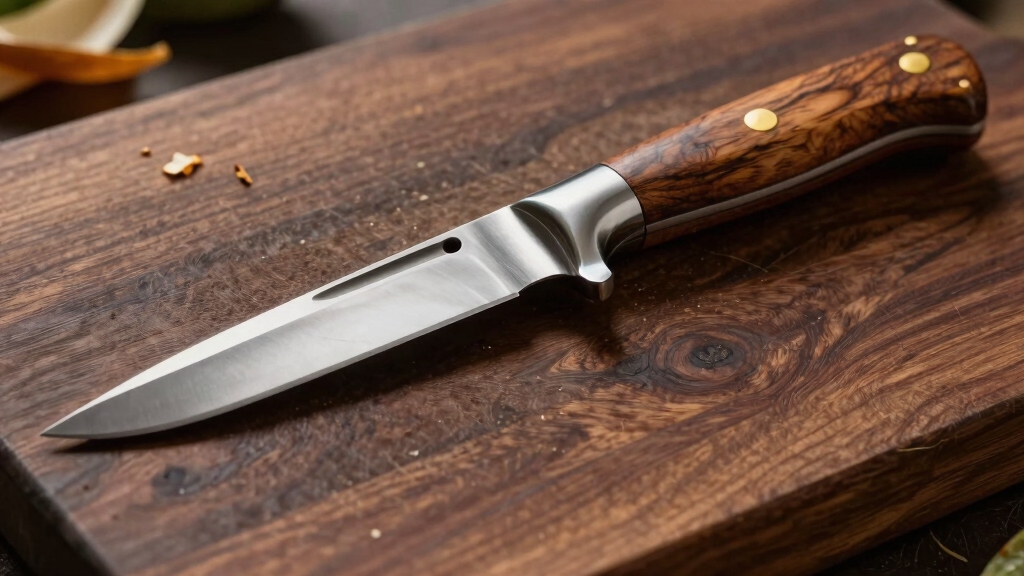
A petty knife is a small, versatile utility blade you’d use for precise cutting, trimming, peeling, and coring tasks where a chef’s knife is too big and a paring knife too small.
Typically 4 to 6 inches long, it features a slender, tapered blade with a sharp pointed tip for accuracy. Crafted from high-quality steels, it balances maneuverability and control.
If you want to fully grasp its design and applications, there’s more to explore ahead.
Key Takeaways
- A petty knife is a small utility blade designed for precision cutting, trimming, peeling, and small butchery tasks in the kitchen.
- It typically features a blade length between 90 mm and 150 mm, balancing versatility and maneuverability for detailed prep work.
- The blade has a slender, triangular profile with a pointed tip, ideal for accuracy and delicate cutting techniques.
- Originating from the French word “petit,” the petty knife was adopted and refined in Japanese culinary culture for ergonomic use.
- Constructed from high-quality steels, petty knives require regular maintenance to preserve sharpness and prevent corrosion.
Definition and Origins of the Petty Knife

The petty knife traces its name to the French word *petit*, meaning “small.”
Japanese culinary culture adopted this term during the Meiji Era as Western kitchen tools and terminology integrated into Japan. Its ergonomic handle design reduces wrist tension, reflecting Japanese knife makers’ focus on user comfort.
This small utility blade filled a niche between paring knives and full chef’s knives, reflecting Japan’s modernization and Western culinary influence.
The term “petty,” used in English, stems from this Japanese adoption rather than an English-language evolution.
Japanese makers refined the petty with thin, hard-edge steels and precise grinds, enhancing its maneuverability and control for delicate kitchen tasks.
Its design balances compact size with versatility, making it essential for precision work like peeling, trimming, and garnishing.
This knife bridges traditional Japanese knife craftsmanship with Western utility concepts.
Additionally, petty knives typically feature a blade length ranging from four to six inches, which contributes to their precision and ease of use.
Typical Blade Length and Shape
When it comes to petty knives, you’ll typically find that their blades range from 90mm to 150mm. This range strikes a nice balance between maneuverability and control, making them quite handy in the kitchen. Their size and shape allow for precise cutting techniques similar to those used with a gyuto knife.
The blade itself has a slender profile with a straight edge and a pointed tip. It kind of resembles a smaller gyuto shape, which is pretty neat. Most petty knives come with a double bevel grind, usually split evenly. But if you’re right-handed, you might notice that some blades favor a 70/30 grind, which is designed for a bit more precision. They originated in Japan during the Meiji Era, reflecting a blend of Japanese and Western culinary traditions, which is why they are considered a small Japanese utility knife.
Standard Length Range
Petty knives typically feature blade lengths ranging from 120mm to 150mm, translating to about 4.7 to 5.9 inches of cutting edge.
The 120mm blade, such as the Masakage Koishi model, measures 4.7 inches, while 130mm blades appear in the Misono series.
The Bunka petty utility often features a 135mm blade, and larger 150mm blades accommodate more demanding chopping tasks.
Although petty knives can vary from 120mm up to 180mm, the standard range centers on 4 to 6 inches for utility work. This size range provides a balance of maneuverability and control ideal for precise kitchen tasks.
They are longer than paring knives but shorter than chef’s knives.
The 150mm blade, weighing around 75 grams, is ideal for precise dicing and rock-chopping, balancing compactness with effective cutting length.
The Masakage Koishi Petty 120mm is notably lightweight at 2.1 oz (60 g), making it easy to handle during detailed prep work.
Blade Profile Characteristics
Although petty knives vary in length, their blade profiles consistently feature a narrow, triangular shape that enhances control and precision. This design is similar in concept to the thin blade design of boning knives, which reduces drag for clean, precise cuts.
Japanese petty blades emphasize this triangular geometry more than Western utility knives, resulting in a thinner, lightweight construction that improves nimbleness.
The blade’s narrow profile, typically around 31mm wide in a 150mm model, encourages a pinch grip for finer handling rather than power holds.
You’ll notice the cutting edge remains straight from heel to tip, enabling precise push-and-pull slicing motions ideal for vegetables.
The pointed tip aligns with the blade’s apex, facilitating detailed work like peeling, trimming, and garnishing.
This slender, lightweight blade design reduces hand fatigue and maximizes maneuverability in tight spaces, making it indispensable for controlled, intricate kitchen tasks.
Additionally, the blade is crafted from AUS-8 stainless steel, known for its corrosion resistance and ease of re-sharpening, ensuring long-lasting sharpness.
Edge and Tip Design
How does blade length and shape influence the edge and tip design of these knives?
Petty knives typically range from 120 to 150mm, with shorter options around 80–90mm. The blade’s slender profile, about 38mm wide in compact models, features a straight edge with a slight curve akin to a miniature Gyuto. This design supports push-cuts, rock-chopping, and fine dicing. The edge angle, usually 14 degrees in high-end variants, guarantees sharpness and precision.
The pointed, flexible tip enables detailed peeling, trimming, and garnishing, while its tapered profile enhances maneuverability in tight spaces. The lighter and more maneuverable blade compared to larger chef knives also helps reduce hand fatigue during extended use, making it ideal for precision tasks requiring fine control lighter and more maneuverable.
Its weight and balance are carefully crafted to ensure comfort and efficiency during intricate kitchen work, similar to the weight and balance considerations found in Gyuto and Santoku knives.
A 120–130mm blade suits delicate tasks, whereas 150mm models offer versatility for chopping. Overall, the edge and tip design balances precision with functional versatility, adapting to various culinary tasks efficiently.
Design and Ergonomic Features
A well-designed petty knife balances blade geometry, weight, and handle ergonomics to enhance precision and reduce fatigue during detailed kitchen tasks. Knife scales play a crucial role in this balance by providing ergonomic grip and comfort to the user.
You’ll find blade lengths typically between 100–165 mm, with slender profiles and pointed tips for nimble peeling and trimming. The blade length selection of around 120 mm to 165 mm offers both precision and versatility in various kitchen tasks.
The knife’s light weight, often under 160 g, and balanced point near the bolster improve control and minimize wrist strain.
Its slim overall length fits confined prep spaces, while reduced tip mass allows swift directional changes.
Handle designs curve or scallop to match finger anatomy, enabling secure, comfortable grips.
You can choose from traditional wa-style or contoured Western handles, each influencing wrist angle and fatigue differently.
Textured, stabilized materials enhance slip resistance without bulk.
Bolster presence affects hand placement, with minimal bolsters enabling closer blade control for precision.
Common Materials Used in Petty Knives

Choosing the right materials for a petty knife blade directly impacts its performance, maintenance, and durability.
When selecting your petty knife, consider these common materials:
- Stainless Steels (e.g., VG-10, AUS-10): Offer corrosion resistance and low maintenance, ideal for everyday use. The Petty Knife often features AUS10 steel, known for its balance of sharpness and durability, making it suitable for precision and utility tasks. AUS-10 is also appreciated for its superior toughness and impact resistance, which enhances durability in rugged use.
- High-Carbon Steels (e.g., Aogami, White Steel): Provide superior hardness and edge retention but need careful rust prevention.
- Powder Metallurgy Steels: Deliver exceptional wear resistance and consistent microstructure, perfect for high-end petty knives.
- San-mai/Clad Construction: Combines a hard steel core with softer stainless cladding, balancing sharpness and toughness. For example, the Osaka Collection Ko-Bunka utilizes a hammered Damascus clad design that adds both aesthetic appeal and functional precision through its hammered Damascus finish.
Each steel’s alloy composition and heat treatment influence hardness and toughness.
Handle materials must complement blade properties for ideal balance and durability. Variability in handle materials and design, such as the customizable handles of the Joey Knife, also influence ergonomics and user comfort, ensuring a balanced and personalized grip.
Comparing Petty Knives to Paring and Utility Knives
When you size up petty knives against paring and utility knives, blade length and shape immediately stand out as key differences.
Petty knives feature blades from 4 to 6 inches, longer than paring knives’ 2.5 to 4 inches but similar to utility knives.
Unlike the straight-edged, rigid paring blade, petty blades curve slightly toward the tip and narrow for flexibility, balancing control and versatility. This curvature enhances cutting precision for a variety of detailed kitchen tasks.
Paring knives have broader, rigid tips, while petty knives’ shallow, sharp tips enhance accuracy.
Utility knives share the curve but suit different cutting angles.
Weight-wise, petty and utility knives weigh between 3-4.5 ounces, heavier than lighter, agile paring knives.
Originating from Japanese tradition, petty knives blend characteristics of European paring and utility knives, serving as a hybrid with unique blade geometry.
This hybrid design allows petty knives to handle small tasks with versatility that might require switching between paring and utility knives.
Ideal Uses and Culinary Applications

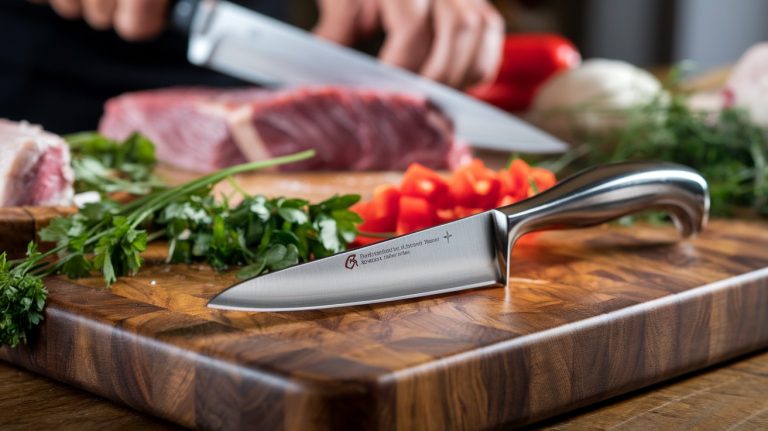
The petty knife is a real superstar in the kitchen, especially when it comes to prepping fruits and vegetables. Imagine effortlessly coring, peeling, and trimming with precision—this knife truly shines in those tasks. Its sharp, narrow blade gives you that extra bit of control for all those detailed garnishing and decorative cuts you might want to try. It is sometimes referred to as the Japanese paring knife, highlighting its distinctive role in Japanese culinary tradition.
And it doesn’t stop there! When you’re trimming meat, the petty knife really shows off its finesse. It can help you remove silver skin and fat cleanly, ensuring you don’t waste any product. Its versatility makes it a handy tool for various kitchen tasks beyond just fruits and vegetables, bridging the gap between specialized knives like boning knives and fillet knives.
Fruit and Vegetable Prep
Mastering fruit and vegetable prep with a petty knife means leveraging its precise blade length and pointed tip to execute detailed peeling, slicing, and mincing tasks. Its smaller size provides excellent maneuverability and precision in tight spaces, making it ideal for intricate work.
You’ll find it excels in handling delicate produce and intricate cuts thanks to its compact design.
- Peel and pare small fruits and vegetables with tight control, minimizing waste and preventing overcutting on curved surfaces like clementines and kiwis.
- Slice and portion baby carrots, mushrooms, and radishes uniformly, enhancing cooking consistency and presentation.
- Mince herbs, garlic, and ginger finely using controlled rocking motions, preserving flavor and reducing bruising. The petty knife is commonly double-beveled, allowing balanced cutting from either hand.
- Create decorative garnishes and precise trims, such as tomato roses or vegetable petals, for refined plating and cocktail embellishments.
This knife’s maneuverability and sharp tip guarantee accuracy in all these tasks.
Meat Trimming Precision
Achieve exact meat trimming by leveraging the petty knife’s slender blade and sharp tip, designed for delicate tasks like sinew removal, fat trimming, and silver skin extraction.
Use the fine tip to initiate precise incisions under sinew. Then slide the flat blade face gently while applying thumb pressure on the bevel for clean separation without meat damage.
Trim fat by cutting along white lines with controlled downward strokes. Angle the blade while pulling fat flaps upward to leave a thin, soft coating.
For silver skin, approach at an angle and pull upward to separate it cleanly from meat, avoiding excessive digging.
Employ a pinch grip with short slicing or rocking motions, maintaining tip engagement. Use heel-to-tip slicing for efficient fat layer guidance.
Garnishing and Detailing
Carving intricate vegetable and fruit designs demands the petty knife’s sharp tip and slender blade for clean, controlled cuts. This knife excels in detailed garnishing tasks that require finesse and precision. Its typical blade length between 11–15 cm makes it perfectly sized for delicate work.
You can rely on it to:
- Sculpt delicate vegetable and fruit patterns, such as flowers or decorative cuts.
- Core and peel small fruits like apples and pears with exact control.
- Trim and slice herbs and vegetables finely without bruising or crushing.
- Prepare artistic garnishes and citrus twists that enhance plating aesthetics.
Its pointed tip allows you to create precise cuts, making it indispensable for culinary presentations that prioritize artistry.
Whether shaping vegetables off the board or mincing herbs, the petty knife fills a vital gap where larger knives lack control, ensuring every detail elevates your dish.
Blade Maintenance and Care Tips
Regularly maintaining and caring for your petty knife guarantees its performance and longevity.
Wipe the blade with a clean, dry cloth during use and rinse it with lukewarm water immediately after.
Keep your petty knife clean by wiping the blade dry during use and rinsing with lukewarm water immediately after.
Clean with a soft sponge and neutral detergent, avoiding dishwashers to prevent damage from harsh detergents and heat.
Dry the blade thoroughly to prevent rust, especially after cutting acidic foods. Do not leave the knife in water or hot water in a dishpan to avoid rust or handle corrosion daily care.
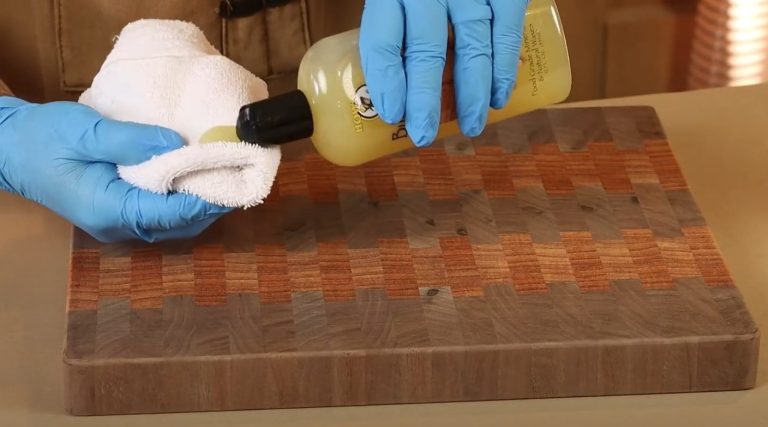
Store the knife wrapped in paper to absorb moisture and apply food-grade mineral or camellia oil monthly to form a protective patina on high-carbon steel.
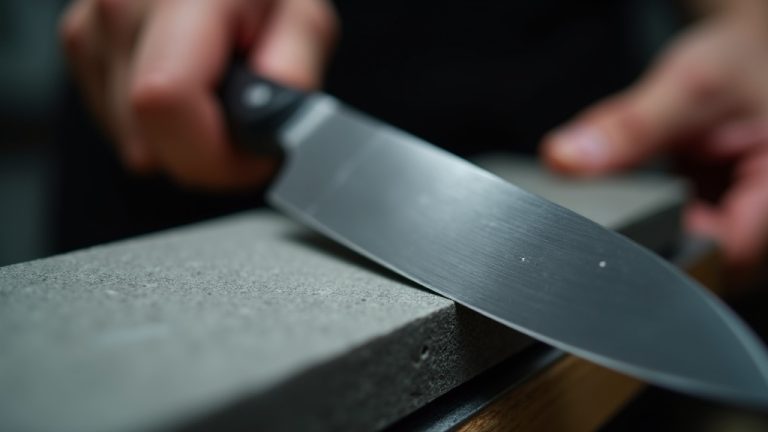
Hone the blade weekly to maintain its razor edge and sharpen once or twice a month depending on use, maintaining a 15-degree angle.
Alternate sharpening front and back, removing burrs with a finishing stone for peak sharpness.
Handle Styles and Materials
The handle of a petty knife plays an essential role in its balance, grip, and overall usability, with styles and materials varying widely to suit different preferences and tasks.
You’ll find traditional Wa-style handles made from lightweight magnolia wood with buffalo horn ferrules, offering a classic feel. Choosing magnolia helps preserve the knife’s original balance due to its lightweight properties.
Western-style full-tang knives often use durable synthetics like POM or pakkawood composites, providing water resistance and mechanical stability.
Modern handles incorporate engineered materials such as micarta or G10, ensuring superior grip and moisture resistance.
- Wa-style: single-piece wood with horn ferrule, lightweight, traditional.
- Western-style: riveted full-tang with synthetic or metal scales, heavier.
- Engineered: resin laminates and composites, high durability, wet grip.
- Ergonomics: wood feels warm, metals cold; texture influences slip resistance.
Benefits of Using a Petty Knife in the Kitchen
You’ll really love how the petty knife offers precision cutting. It allows you to handle delicate tasks, like trimming vegetables and herbs, with such exceptional control.
Plus, its versatile design fills the gap between paring and chef’s knives, making it perfect for all kinds of small-scale prep work. The petty knife typically features a 4 to 6 inch blade, which is ideal for detailed kitchen tasks.
This combination of features not only enhances your efficiency but also boosts your accuracy across a variety of kitchen tasks. So, whether you’re slicing, chopping, or dicing, the petty knife is definitely a game-changer in your cooking routine!
Precision Cutting Advantages
Experience unmatched control and precision with a petty knife, designed to excel in intricate kitchen tasks. Its smaller blade profile and pointed tip let you carve vegetables and fruits with exceptional accuracy. The grip placement and ample blade clearance prevent knuckle bumps, enhancing comfort and control. The petty knife’s blade is slightly curved toward the tip, allowing for greater flexibility in delicate cutting motions.
- Execute fine decorative cuts and garnishes with sharp, shallow tips.
- Perform precise slicing of herbs and removal of vegetable cores without damage.
- Peel and trim fruits or vegetables delicately, maintaining texture integrity.
- Leverage a sturdy spine for tougher tasks like removing sinew or small bones.
Versatility in Tasks
When handling delicate ingredients or detailed tasks, a petty knife offers unmatched versatility that adapts seamlessly to varied kitchen demands.
Its blade length (120–165 mm) and pointed tip enable precise slicing, coring, trimming, and peeling. You’ll appreciate its narrow profile that reduces drag and preserves ingredient integrity, from soft berries to small cuts of meat. Many petty knives feature double-beveled edges for ambidextrous use, enhancing comfort and control regardless of hand preference.
This tool consolidates multiple functions, streamlining workflow and reducing tool switches.
| Task Category | Key Petty Knife Benefits |
|---|---|
| Small-Ingredient Prep | Clean slices, minimal crushing, access to cores |
| Herb & Garnish Work | Fine mincing, decorative shaping, zesting |
| Trimming & Butchery | Precise fat removal, portioning, tendon scoring |
Choosing the Right Petty Knife for Your Needs
Narrowing down the right petty knife starts with understanding your specific tasks and hand size. Consider these factors:
- Blade Length: Choose 75-100mm for paring; 120mm for versatile prep; 150mm for light butchery. The most practical blade length for everyday small-item work is typically 120–130mm, ideal for fruits, small ingredients, and peeling.
- Steel Type: Pick high-carbon steel for sharpness and edge retention if you maintain blades. Stainless steel suits beginners with low upkeep.
- Handle Style: Opt for Japanese wa-style handles if you prefer a lighter, pinch grip. Western handles suit hammer grips with robust durability.
- Edge Geometry: Double-beveled edges suit ambidextrous use. Straight, pointed tips provide precision; triangular profiles enhance agility.
Match these attributes to your prep style and tasks to guarantee efficient, comfortable handling and peak performance in your kitchen.
Frequently Asked Questions
Can a Petty Knife Be Used for Outdoor or Camping Tasks?
Yes, you can use a petty knife for outdoor or camping tasks, especially for precise food prep like peeling, slicing small produce, and trimming fish or meat.
Its smaller blade is lightweight and packable, making it convenient for travel. However, avoid heavy-duty jobs like chopping wood or cutting thick rope, as the fine edge can chip or roll.
Always carry it in a protective sheath and maintain the blade to guarantee durability in outdoor conditions.
Are Petty Knives Suitable for Left-Handed Users?
Yes, petty knives can suit left-handed users if you select models with symmetrical double-bevel grinds and ambidextrous handles.
Avoid knives with offset bolsters or finger guards that favor right-hand grips, as these impede control.
Look for round or neutral handles and consider mirror-ground blades or left-specific versions for optimized edge geometry.
Testing blade length around 120–135 mm helps maintain precision and comfort during left-handed use.
How Do Petty Knives Perform With Frozen or Hard Foods?
You know what they say: “The right tool makes the task easier.” Petty knives perform well on frozen or hard foods thanks to their sturdy spine and slender blade.
While they can handle small bones and tough tendons, their narrow profile limits heavy chopping force. You’ll find them excellent for precise push-and-pull slicing, coring hard veggies, and trimming frozen meat.
However, avoid high-force tasks better suited for heavier knives like gyuto or deba.
What Safety Precautions Are Unique to Petty Knife Use?
When using a petty knife, you need to pay special attention to your grip and cutting angle due to its smaller blade. Always curl your fingertips under with a claw grip to avoid slips.
Keep the blade angled away from your body and avoid twisting through tough ingredients to prevent chipping. Use a stable cutting surface and focus on controlled push-cuts or fine dicing.
Clean and store it properly to maintain sharpness and avoid accidents.
Can Petty Knives Be Sharpened With Standard Kitchen Sharpeners?
Imagine you use a standard pull-through sharpener designed for typical kitchen knives.
Yes, you can sharpen your petty knife this way if the sharpener supports a 15°–20° edge angle, matching your petty’s geometry.
However, mechanical sharpeners with higher fixed angles risk dulling its fine edge and reducing slicing performance.
For high-hardness steels, you’ll get better results using whetstones, which allow precise angle control and gradual grit progression to maintain your petty’s sharpness.
Why Skip a Petty Knife No More?
Now that you’ve got the lowdown on petty knives, you’re ready to add this versatile tool to your kitchen arsenal.
With its precise blade and ergonomic design, it’s perfect for detailed tasks where bigger knives fall short.
Remember, having the right knife can make all the difference. It’s the secret sauce to efficient prep work.
Keep it sharp, choose quality materials, and you’ll slice and dice like a pro every time.